What kind of hacker are you?
The difference between them
What is a hacker?
The term ‘hacker’ does not necessarily have a negative connotation. For the original generation of hackers, it represented a blend of technical expertise, curiosity, and kindness.
A hacker is an individual who uses a computer, networking, or other skills to overcome a technical problem. Over the years, the word has been used to refer to anyone who uses their abilities to gain unauthorized access to systems or networks to commit crimes. A hacker may, for example, steal information to hurt people via identity theft or bring down a system and, often, hold it hostage to collect a ransom.
In case you were wondering where the word ‘hack’ came from… it has been around since April 1955. It was used in a meeting of the MIT Tech Model Railroad Club.
The minutes from that meeting read: “Mr. Eccles requests that anyone working or hacking on the electrical system turn the power off to avoid fuse blowing.”
The college students are also credited with shifting the term from model railways to computers in the 1960s.
Grey, White, and Black hat hackers.
‘Hat’ color is one of the first ways to differentiate computer hackers.
-
- Black Hat: conducts hacking activities without owner consent and with malicious intent.
-
- White Hat: conducts hacking activities with the consent of the technology owner.
-
- Grey Hat: conducts hacking activities without owner consent but usually stops short of malicious activities.

Black Hat hackers
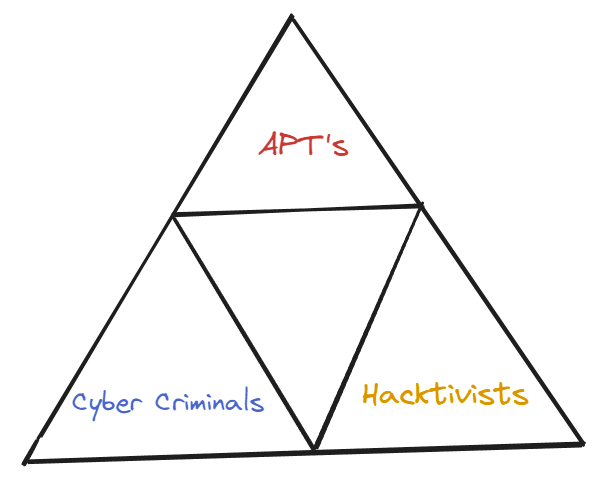
Black hat hackers can be divided into threat actors, differentiating into categories based on their motivation, capability, and intent.
APT’s Motivation: Stealing intellectual property or information to advance a political agenda.
Cyber Criminals Motivation: Stealing money or data that can be monetized.
Hacktivists Motivation: Furthering political goals or just causing chaos.
Nation-State Actors (APT)
Nation-state actors work for governments to disrupt or compromise other target governments, organizations, or individuals to gain access to intelligence or valuable data. They have been known to create significant international incidents and are known as Advanced Persistent Threats (APT) or simply Advanced Threats.
Generally speaking, they can operate without fear of legal retribution in their home country and are often part of ‘hackers for hire’ companies aligned to the aims of a government or dictatorship.
Hacktivists
Hacktivists generally operate within the social or political sphere, breaking into and damaging computer systems and networks. Their targets can vary dramatically, from the Church of Scientology to pharmaceutical companies and drug dealers.
Hacktivism combines the words ‘Hacking’ and ‘Activism.’ One of the most famous hacktivist groups in recent times is Anonymous, and it is well worth reading about.
Cyber Criminals
Cybercriminals are individuals or teams that commit malicious activities on networks and digital systems to steal sensitive organizations or personal data and generate profit.
It’s important to note that the distinction between cyber criminals and nation-state actors is becoming increasingly blurred.
Additional Research
If you want to learn more about black, grey, and white hat hackers. Here are a few exciting names that a simple search will return a lot of information on:
-
- Tim Berners-Lee is famous for inventing the World Wide Web and is a white hat hacking camp member.
-
- Gary McKinnon — Gained access to over 97 military networks and left the message on their system, “Your security is crap.”He says he was looking for a UFO cover-up.
-
- Michael Calce (AKA MafiaBoy) launched a series of highly publicized DoS attacks against large organizations.
There are many names and stories for you to read about… A big part of being curious, after all!
Thanks for reading.