The threat of Malware in Cybersecurity
The threat of Malware in Cybersecurity: Understanding the Risks
This study aims to review and discuss the structure and overall quality of the content offered by ChatGPT. This review is based on essential elements such as clarity and the flow between paragraphs to engage the reader.
Other criteria supporting this review are critical insight, inherent bias, the writing style adopted, objectivity, evidence provided, and tone throughout the paper.
During a six-week study on artificial intelligence (AI), I carefully crafted queries limited to 2000 words on “Challenges of Malware in Cybersecurity.” The queries required academic citations and at least five references and had to be written in APA format. It took thirteen attempts to rephrase and get the desired result.
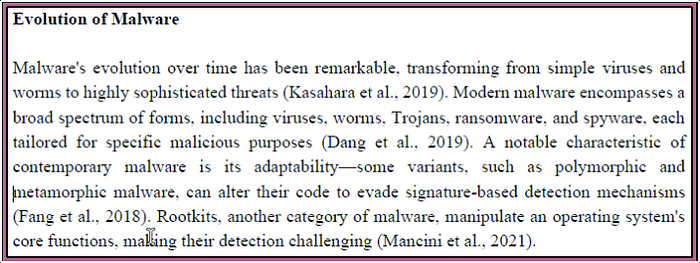
ChatGPT delves into the evolution of malware in cybersecurity and its evolution over time and encompasses the adverse effects that impact enterprises and individuals. AI reflects on malware detection, human errors, and strategies adopted to reduce challenges promptly.

The essay is well-structured, providing a clear introduction and paragraphs for further discussion. However, the narrative needs to flow from one section to another, which increases the difficulty of readiness and following throughout the paper.
ChatGPT provides a basic understanding of the topic without presenting too many details, starting with a wide range of elements, from describing the evolution to the impact and the entities affected by the subject matter. The essay uses a short, sentenced approach with no critical insight and no proper data and statistics as proof of more profound research.
The tool lacks critical thinking and in-depth argumentation, leading to a limited understanding of the subject matter. While it presents balanced summaries and various viewpoints, its academic limitations include factual inaccuracies and biased evaluations.
“Challenges of Malware in Cybersecurity”

ChatGPT was updated in September 2021 (Yang, 2023). It’s important to acknowledge that bias could arise from using training datasets from the internet and the algorithm used for training the data.
Since its last update in 2021, the AI has had limitations regarding academic integrity and real-time internet connectivity, meaning it can’t provide updated information. However, you can access updated information by signing up for a premium membership with version 4.0, which costs about $20/month.
“Challenges of Malware in Cybersecurity”

Reflection on the use of AI
Artificial Intelligence (AI) is undoubtedly one of the most popular and advanced technologies in the digital era. Generative AI has gained immense popularity quickly owing to its ability to create text, images, audio, and many other human-friendly texts. Different types of generative AI are designed to perform various tasks, and some are more popular than others.
ChatGPT is a powerful generative AI model designed to understand human language. It has over 100 million users and received 1.6 billion visits in June 2023. This three-month traffic volume set a new record and continues to grow. ChatGPT can generate contextually relevant text for various fields, including medicine, web development, and academic use.
Evaluating the sources used by the AI

My experience with ChatGPT has been exceptional, and using it to structure and refine academic papers can benefit students if used ethically.
AI is constantly advancing, and it is hoped to have access to various sources to provide accurate citations in the future. As technology evolves, humans must adapt, learn, and improve.
I plan to research code visualization more to make it more understandable for programmers. My goal is to adjust code parameters and components more efficiently.

The Future of ChatGPT
The future of ChatGPT is bright and promising. We can expect even more natural and contextually aware conversations as they evolve and improve. The potential applications are vast, from enhancing customer experiences to making content creation more efficient.
In conclusion, ChatGPT represents a significant step forward in AI-powered natural language understanding and generation. It’s a tool that has the potential to revolutionize how we interact with machines, generate content, and provide customer support. Addressing ethical concerns and harnessing its capabilities responsibly is essential as it becomes more integrated into our daily lives. ChatGPT is not just a technology; it’s a glimpse into the future of human-AI collaboration.
The AI Profit Masterclass free book covers everything you need to know about using AI to make income online.
You can download the free book here.
Thanks for reading.
Related article-
AI a Game Changer for Search Engines and SEO Future.